5 common misconceptions about specialty coffee


Why what we think we know about coffee is often wrong.
Specialty coffee is experiencing a real boom. Yet, it remains surrounded by many misconceptions that still prevent many enthusiasts from discovering its full richness.
At La Réminiscence , we meet people every week who are convinced that specialty coffee is necessarily stronger, more acidic, or reserved for an elite. The reality is quite different.
Here are the five most common misconceptions.
1. "Specialty coffee is stronger"
This is probably the most widespread misconception.
Many people associate the intensity of the taste with a high caffeine content. However, these two concepts have no direct link.
A coffee can have a rich aromatic profile while containing less caffeine than an industrially produced coffee.
Specialty coffee is selected for its flavor qualities: balance, smoothness, complexity, and length on the palate. The aim is to reveal the natural aromas of the terroir, not to mask flaws through excessive roasting.
The result is often a more elegant, more expressive and paradoxically easier-to-drink cup.

2. "The blacker the coffee, the better it is."
For a long time, a very dark roast was perceived as a sign of quality.
In reality, excessive roasting homogenizes the flavors.
Smoky, burnt or bitter notes then take over and completely mask the characteristics of the coffee.
Conversely, controlled roasting respects the producer's work and allows the true aromas to emerge:
fruits
flowers
chocolate
spices
citrus
dried fruit
Honey
The roaster's role is not to transform the coffee, but to reveal its identity.
3. "Acidity is a defect"
The word acidity often evokes fear.
However, in the vocabulary of specialty coffee, acidity is a quality.
It is not an aggressive sensation like that of poorly extracted coffee.
We're talking more about a natural freshness that brings liveliness to the cup.
She can recall:
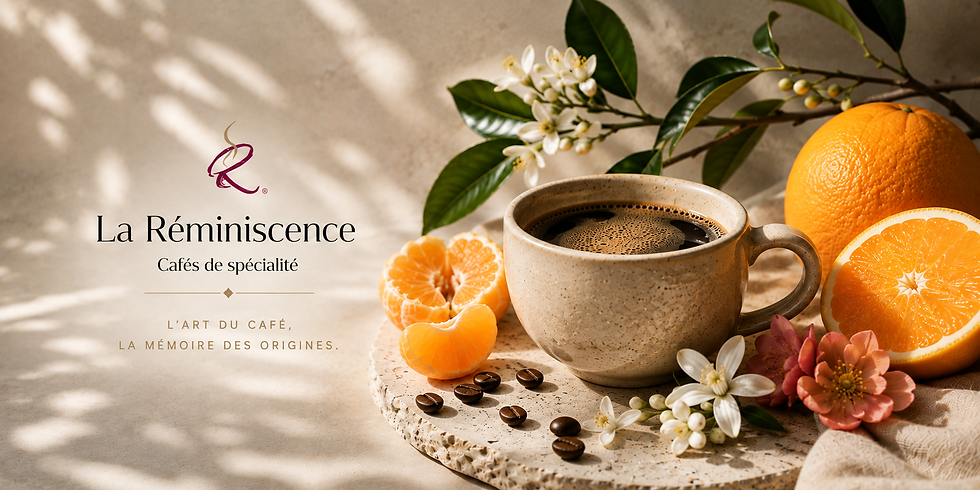
a ripe orange
a tangerine
an apple
a peach
red berries
This balanced acidity gives depth to the coffee and contributes to its overall balance.
Like a great wine or an excellent tea, it brings elegance and length on the palate.
4. "Specialty coffee is reserved for experts."
Quite the opposite.
Specialty coffee is not meant to impress, but to provide pleasure.
You don't need to know extraction methods or master the vocabulary of tasters to appreciate a beautiful cup of coffee.
It all starts with a simple question:
"Do I like what I'm drinking?"
Over time, the palate naturally learns to recognize certain aromatic families.
The experience remains primarily sensory.
Specialty coffee is an invitation to slow down, to take the time to taste and rediscover a drink that many consume daily without really savoring it.
5. "It's just marketing."
While specialty coffee is often presented with care, its value is based primarily on objective criteria.
To be considered specialty coffee, a coffee must obtain a minimum of 80 points out of 100 according to the international protocol of the Specialty Coffee Association (SCA).
This assessment takes into account numerous criteria:
absence of major defects
harvest quality
precision of processing
aromatic balance
candy
persistence
complexity
Behind every coffee are also producers who work with great care, often on small plots, with harvests done manually.
Buying specialty coffee also means supporting a sector that values the work of producers more.
Beyond preconceived ideas
Specialty coffee is neither a fad nor a product reserved for a few connoisseurs.
This is another way of approaching coffee.
An approach where every step counts:
the local produce,
the botanical variety,
the producer's work,
roasting,
extraction.
Each cup tells a story.
At La Réminiscence , we believe that coffee deserves to be enjoyed with the same care as a great wine or an exceptional spirit.
Not to make it complicated, but to restore its full value.
The next time you make coffee, take a few seconds to observe its aromas before the first sip.
You may be surprised to discover that a coffee can evoke a flower, a citrus fruit, a dark chocolate, or even a delicate tea.
It is precisely this richness that makes specialty coffee so beautiful.

Each coffee in our collection is selected to reveal the truest expression of its terroir. From the floral elegance of Ethiopia to the deep notes of Indonesia, our coffees are hand-roasted in Martinique to reveal their full aromatic complexity.


Comments